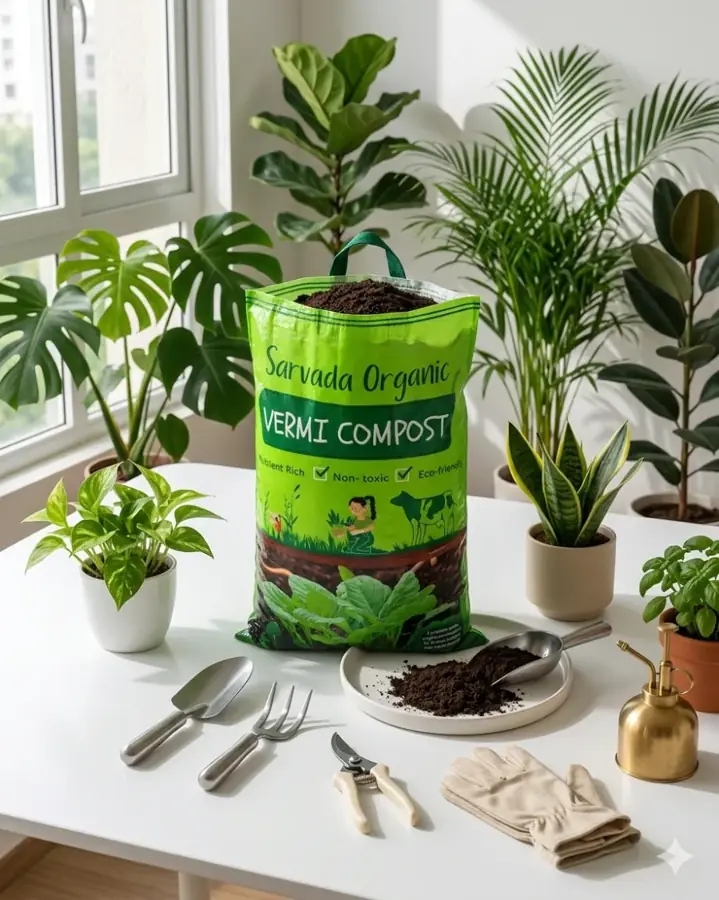
Best Fertilizer for Indoor Plants: Simple Soil and Feeding Guide
Indoor plants do not want heavy feeding. They need airy mix, small vermicompost doses and enough patience to let new leaves arrive.
By Sarvada Farm Team
From Sarvada Organic's farm team, based on small-batch vermicompost production and Indian balcony-garden support since 2018.
The best fertilizer for indoor plants is not the strongest one. It is the one you can use lightly without turning the pot into a wet, heavy mess. For most Indian homes, that means vermicompost every 45-60 days in a loose potting mix.
Indoor plants live slower lives than balcony plants. They get less sun, lose less water, and use food more slowly. Feeding them like a tomato plant in full sun is like serving a full thali to someone who only asked for tea.
At Sarvada, our safest indoor advice is boring on purpose: feed less than you feel like feeding, keep the mix loose, and let the plant show active growth before increasing food.
Start here
Best fertilizer for indoor plants: the simple answer
Use mature vermicompost as the regular food. It is mild, easy to dose, and it supports the soil instead of forcing sudden leaf growth. Indoor plants rarely need heavy feeding unless they are in bright light and actively growing.
University of Georgia Extension explains indoor plant success through the balance of light, water, temperature, humidity, soil and fertilizer. That balance matters because fertilizer cannot fix a dark corner, a blocked drainage hole, or a pot that stays wet for a week.
| Plant type | Vermicompost dose | How often | Note |
|---|---|---|---|
| Money plant, pothos, philodendron | 2-4 tablespoons for an 8-inch pot | 45-60 days | Use less in low light |
| Snake plant and ZZ plant | 1-2 tablespoons | 60-90 days | These plants dislike wet, rich soil |
| Peace lily and palms | 3-5 tablespoons | 45-60 days | Feed only when new leaves are coming |
| Herbs near a sunny window | 3-4 tablespoons | 30-45 days | They use more food than decorative plants |
| Recently repotted plants | Skip top feeding | Wait 30-45 days | Fresh mix usually already has compost |
Garden soil mix is not the same as potting mix
Garden soil is made for open ground. Potting mix is made for a container. That difference matters indoors because the pot is a closed room for roots. If the room has no air, fertilizer only makes it wetter and heavier.
Illinois Extension says container media must drain and breathe. University of Georgia Extension also points out that poor aeration and excess moisture stress roots in containers. That is why plain garden soil often fails inside pots.
A good indoor potting mix recipe
Use this as your default indoor potting mix. Measure with any one scoop: a mug, katori, bowl or garden trowel. The ratio matters more than the tool.
| Ingredient | Amount | Job |
|---|---|---|
| Garden soil or red soil | 3 scoops | Weight and mineral structure |
| Cocopeat | 4 scoops | Moisture holding and softness |
| Vermicompost | 2 scoops | Slow organic food |
| Perlite, rice husk or coarse sand | 1 scoop | Air and drainage |
The mix should feel like moist poha: soft, airy and crumbly. If it feels like wet dough, add more rice husk, perlite or coarse sand before planting.
For plant-specific ratios, use the full potting mix guide. For dose by pot size, keep the vermicompost spoon guide open while feeding.
Organic fertilizers that work indoors
- Vermicompost: best regular food for most indoor pots.
- Vermiwash: useful as a light diluted spray or drench, but not every day.
- Neem cake: useful in tiny amounts for soil support, especially when repotting.
- Composted leaf mould: good for texture, but not a complete fertilizer.
- Cow dung manure: avoid indoors unless it is fully decomposed, dry, low-smell and used very lightly.
How to apply natural plant fertilizer indoors
- Check that the plant is getting enough light for new growth.
- Loosen only the top finger-depth of soil.
- Sprinkle the measured vermicompost like a thin blanket.
- Keep one finger gap around the stem.
- Water once, then wait until the top layer dries before watering again.
Signs you are overfeeding indoor plants
- White or grey crust on topsoil.
- Fungus gnats around the pot.
- Sour smell after watering.
- Soft new growth that bends easily.
- Yellowing after feeding, especially in low light.
Sarvada note
If you want a low-smell regular feed for indoor pots, compare the Sarvada vermicompost packs and start with the smallest size that matches your plant count.
Frequently asked questions
For most indoor plants, pure vermicompost is the safest regular fertilizer. Use it lightly every 45-60 days and reduce the dose in low light.
Use garden soil only as one part of a potting mix. Plain garden soil becomes compact in containers, so mix it with cocopeat, vermicompost and an air material.
Use 3 scoops soil, 4 scoops cocopeat, 2 scoops vermicompost and 1 scoop perlite, rice husk or coarse sand.
Yes, when used lightly. Vermicompost is usually safe indoors. Avoid fresh cow dung manure because it can smell, stay wet and harm roots.
Every 45-60 days during active growth is enough for most indoor plants. Snake plant and ZZ plant can wait 60-90 days.
Yes. Too much organic fertilizer can keep soil wet and attract fungus gnats. Use small measured doses instead of covering the whole pot heavily.
Try Sarvada Organic
Pure vermicompost from ₹249 · Lab N 3.16%
No silt, no preservatives. Free delivery above ₹499 and Cash on Delivery on Amazon.
Buy on Amazon