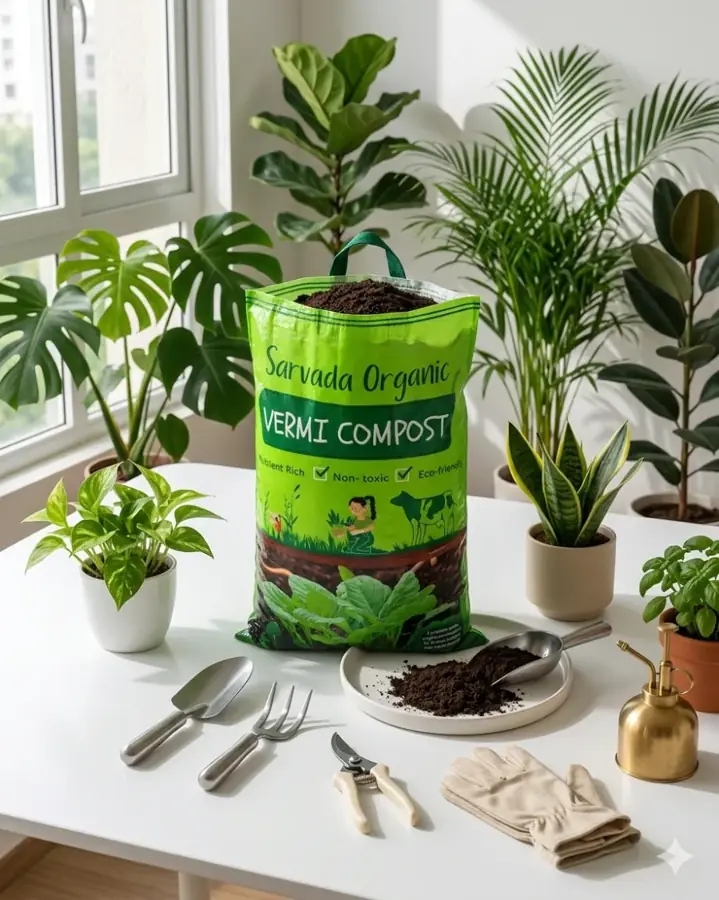
The right potting mix for every plant — a no-nonsense guide for Indian homes
Indoor foliage, flowers, vegetables, succulents and seedlings each need a different mix. These five recipes are enough for most homes.
By Sarvada Farm Team
From Sarvada Organic's farm team, based on small-batch vermicompost production and Indian balcony-garden support since 2018.
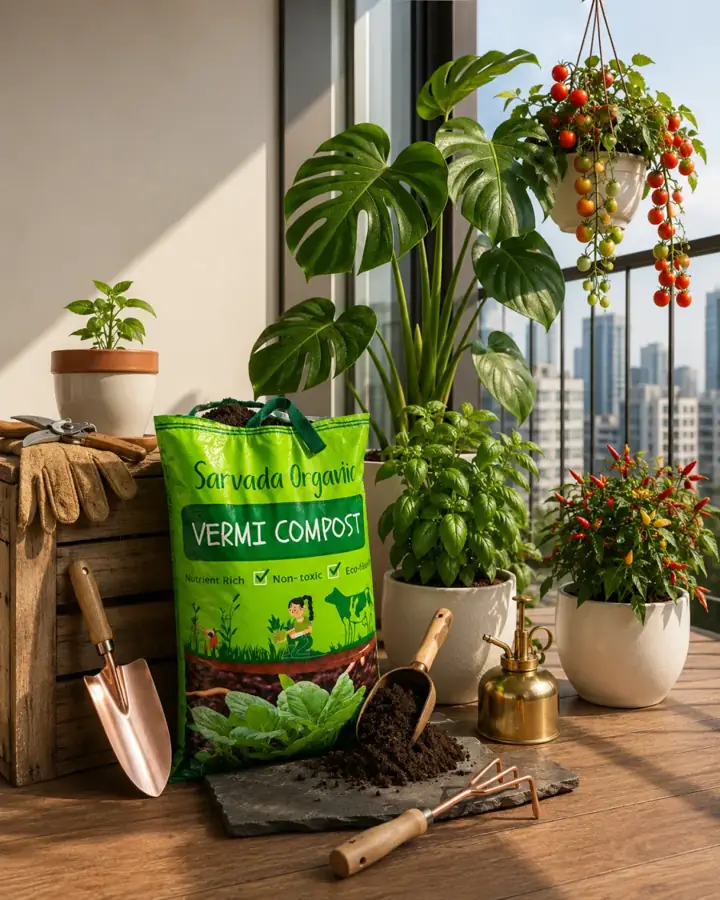
If you do not want to think in percentages, use a 10-scoop potting mix: 4 scoops garden soil, 4 scoops cocopeat and 2 scoops vermicompost. It works for money plant, tulsi, pothos, palms, herbs and most balcony pots. Special plants only need small changes.
Potting mix is not plant food. It is the room the roots live in. If that room has no air, no drainage, or too much wetness, even the best fertilizer cannot rescue the plant.
Start here
The 10-scoop rule
Do not start with percentages. Start with a bowl, a mug or your hand. If one scoop means one katori, the recipe is still the same. The goal is simple: structure, moisture, gentle food, and enough air space for roots.
| Plant type | Garden soil | Cocopeat | Vermicompost | Extra |
|---|---|---|---|---|
| Indoor foliage: money plant, pothos, palm, monstera | 4 scoops | 4 scoops | 2 scoops | Optional 1 scoop perlite if the room is humid |
| Flowering plants: rose, hibiscus, jasmine | 3 scoops | 3 scoops | 3 scoops | 1 scoop perlite, rice husk or coarse sand |
| Vegetables: tomato, chilli, brinjal, methi | 3 scoops | 3 scoops | 2 scoops | 2 scoops leaf mould, composted manure or rice husk |
| Succulents and cacti | 2 scoops | 1 scoop | 1 scoop | 6 scoops coarse sand, perlite, pumice or brick chips |
| Seedlings under 30 days | 0 scoops | 7 scoops | 1 scoop, finely sieved | 2 scoops perlite or vermiculite |
Why garden soil alone fails in pots
Good garden soil can make terrible pot soil. In the ground, extra water can move sideways and roots can travel deeper. In a pot, the same soil becomes a small locked box. Illinois Extension says container media must drain and breathe, and that garden soil by itself blocks both.
University of Georgia Extension explains the same thing in root language: excess moisture and poor air stress roots and invite root-rotting fungi. That is why the best mix feels like moist poha, not wet dough. It should hold shape lightly, then crumble when you press it.
What each ingredient does
| Ingredient | Job in the pot | Common mistake |
|---|---|---|
| Garden soil or red soil | Gives weight, minerals and structure | Using it alone, especially if it is clay-heavy |
| Cocopeat | Holds water and keeps the mix light | Using dry bricks without soaking and squeezing first |
| Vermicompost | Adds slow food, microbes and organic matter | Making it the whole potting mix |
| Perlite, rice husk, pumice or brick chips | Creates air pockets and faster drainage | Skipping it for succulents or very wet balconies |
| Coarse sand | Adds drainage and weight | Using fine construction sand or beach sand |
| Leaf mould | Softens vegetable and flowering mixes | Using fresh leaves that are still breaking down |
How to adjust for Indian homes
If your soil becomes a hard cake
Use less garden soil and more cocopeat or rice husk. This usually happens with heavy clay, black cotton soil, or silt-heavy compost. For a 10-scoop mix, move from 4 scoops soil to 2 or 3 scoops soil.
If your balcony stays wet after rain
Use less cocopeat and add more air material. In monsoon, a pot that stays wet for two days is not being "well watered"; it is stuck. Add perlite, pumice, rice husk, brick chips, or coarse sand.
If your terrace dries in one afternoon
Keep the 4 scoops cocopeat, add mulch on top, and water deeply instead of sprinkling. Dry heat punishes shallow watering. A thin layer of dry leaves or coco chips on top saves more water than adding extra compost.
If you are starting seeds
Keep the mix light. University of Maryland Extension describes seed-starting media as soilless and moist like a wrung-out sponge, not soppy wet. For Indian homes, cocopeat plus perlite or vermiculite does that job well. Add only a little sieved vermicompost after the first true leaves appear.
What not to mix
- Fresh cow dung. It can heat, smell, bring weed seeds, and burn young roots. Use only well-rotted manure in outdoor beds.
- Fine construction sand. It packs into the gaps and makes the pot heavier without improving drainage.
- Too much wood ash. A pinch is enough. A cup can push the mix too alkaline for many home plants.
- Only cocopeat. It holds water but has no real structure for long-term plants unless you mix in compost and minerals.
- Only vermicompost. It is food, not a full house for roots. Too much can keep small pots wet and heavy.
How to mix it without wasting material
- Soak cocopeat fully, then squeeze it until it feels damp, not dripping.
- Sieve garden soil and vermicompost so stones and hard lumps stay out.
- Measure with one scoop size and mix dry ingredients first.
- Add water slowly until the mix clumps lightly in your fist.
- Fill the pot, tap the sides once, and leave one inch at the top for watering.
When to refresh the mix
- Every 12 months - remove the top 2 inches and replace with fresh mix.
- Every 18-24 months - repot fully if the plant is root-bound or water stops draining well.
- When water pools - if water sits on the surface for more than 30 seconds, refresh sooner.
- After root rot - do not reuse the same wet, sour mix for another plant.
Sarvada note
Frequently asked questions
Use 4 scoops garden soil, 4 scoops cocopeat, and 2 scoops vermicompost. Add 1 scoop perlite if your room or balcony stays humid.
Use 3 scoops soil, 3 scoops cocopeat, 2 scoops vermicompost, and 2 scoops leaf mould, composted manure, rice husk, or perlite. Vegetables need food, drainage, and root space.
Yes for seedlings and short-cycle microgreens, but not for long-term pots. Most plants need some mineral structure from soil or another stable base ingredient.
It usually has too much clay, fine sand, or silt-heavy compost. Add cocopeat and an air material like perlite, rice husk, pumice, or coarse sand.
Garden soil is useful only after amendment. By itself it becomes too compact in containers, so mix it with cocopeat, vermicompost, and a drainage material.
Use a gritty mix: 2 scoops soil, 1 scoop cocopeat, 1 scoop vermicompost, and 6 scoops coarse sand, perlite, pumice, or brick chips.
Refresh the top 2 inches every 12 months. Fully repot every 18-24 months, or sooner if water pools, roots circle the pot, or the mix smells sour.
Try Sarvada Organic
Pure vermicompost from ₹249 · Lab N 3.16%
No silt, no preservatives. Free delivery above ₹499 and Cash on Delivery on Amazon.
Buy on Amazon