How Much Vermicompost Per Plant? Spoon Chart for Pots
Exact spoon, teacup and handful doses for Indian pots — how much per plant, how often every 30 days, and which pack to buy.
By Sarvada Farm Team
From Sarvada Organic's farm team, based on small-batch vermicompost production and Indian balcony-garden support since 2018.
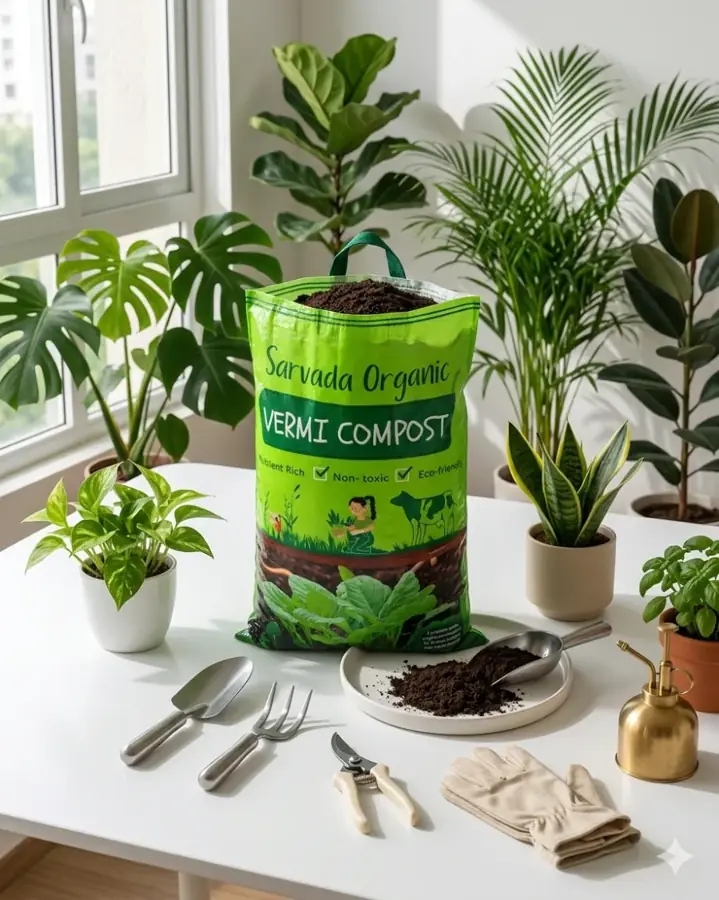
For most potted plants, use vermicompost like a topping, not like soil: 2-3 teaspoons for a tiny nursery pot, 4-5 tablespoons for a 6-inch pot, half a teacup for an 8-inch pot, and one full teacup for a 12-inch pot. Sprinkle it on top, lightly mix the surface, and water once. Repeat every 30-45 days during active growth.
This guide was refreshed in July 2026 for Indian balcony pots, grow bags and monsoon watering. The spoon measures below still match how we pack and recommend Sarvada vermicompost for home gardens.
Start there. Then adjust: bigger pots get more, indoor plants get less, fruiting vegetables get fed more often, and wet monsoon soil gets a lighter hand. Think of it like adding masala to food. A little improves everything; a heap does not make the plant twice as happy.
Quick answer
How much vermicompost per pot? (spoon chart)
Use this table for top dressing existing pots. Do not press the compost down like cement. Sprinkle it, spread it, and mix only the top layer so it looks like the soil has been dusted with dark coffee powder.
| Pot size | Use this much on top | How often | Best use |
|---|---|---|---|
| 4-5 inch nursery pot | 2-3 teaspoons | 45-60 days | Small herbs, cuttings, young indoor plants |
| 6 inch pot | 4-5 tablespoons, or 1 loose handful | 30-45 days | Tulsi, money plant, pothos, small flowering plants |
| 8 inch pot | Half a teacup, or 7-8 tablespoons | 30-45 days | Medium indoor plants, herbs, small chillies |
| 10 inch pot | Three-quarter teacup, or 1 small katori | 30 days | Rose, hibiscus, curry leaf, brinjal, chilli |
| 12 inch pot | 1 full teacup | 30 days | Tomato, capsicum, larger flowering plants |
| 14-16 inch pot | 2 teacups | 30 days | Fruit-heavy vegetables, large ornamentals |
| 18 inch grow bag | 4-5 teacups | 20-30 days in fruiting season | Tomato, gourds, okra, balcony vegetables |
| Raised bed | A thin one-finger layer over the surface | 30-45 days | Leafy greens, mixed vegetables, terrace beds |
Buy the pack that matches your balcony
How much vermicompost per plant?
Gardeners search “per plant,” but the safe answer is still pot size. One tomato in an 18-inch grow bag needs far more than one tulsi in a 6-inch pot. Use the spoon chart above, then nudge up only for heavy feeders in active fruiting.
- One plant in a 6-inch pot: 4-5 tablespoons every 30-45 days.
- One plant in an 8-10 inch pot: half to three-quarter teacup every 30-45 days.
- One tomato / chilli in a grow bag: 4-5 teacups every 20-30 days while fruiting, if drainage is excellent.
- Several seedlings in one tray: mix lightly into soil before sowing; do not top-dress each seedling heavily.
How often to apply vermicompost to potted plants?
For most Indian balcony pots, every 30 days is the default during active growth. Stretch to 45-60 days for indoor foliage in low light. Compress to 20-30 days only for fruiting vegetables in large pots or grow bags.
Weekly feeding is almost never useful in home containers. It packs the topsoil with organic matter, holds water, and invites fungus gnats — especially in monsoon.
Should I mix vermicompost into soil or put it on top?
For an existing plant, top dress. Scratch the top layer loose, spread the vermicompost, mix it only into the top finger-depth of soil, and water. Do not dig deep around the root ball just to "mix it properly"; most pot damage happens from that one well-meant mistake.
For a new potting mix, use a scoop rule: 1 scoop vermicompost for every 3-4 scoops of your base mix. If you are using a kitchen bowl, that means one bowl of vermicompost for three or four bowls of cocopeat, soil, leaf mould, perlite, sand, or rice husk.
Why the 1-scoop-in-4 rule is the safest starting point
Different guides phrase it differently, but they land in the same range. Oklahoma State Extension suggests using worm castings as roughly one quarter to one third of a potting mix, while Oregon State Extension puts typical container use at about one quarter of total soil volume. For home pots, that is why the 1-scoop-in-4 rule works so well: enough food for the plant, not so much that the mix becomes heavy.
A 2019 meta-analysis in Agronomy for Sustainable Development found the strongest growth response when vermicompost made up a bigger share of the soil volume. I still prefer the 1-scoop-in-4 rule for balcony containers because pots need air space, drainage, and root movement. Once a mix becomes too rich and too dense, the plant may grow leaves while flowers and fruit slow down.
How to apply vermicompost without wasting it
- Water lightly first if the soil is bone dry. Dry soil pulls water away from the compost and leaves it sitting on top.
- Loosen the top finger-depth with your fingers or a fork. Stop when you start seeing fine roots.
- Add the measured amount from the table. Keep a small gap around the stem so the crown does not stay wet.
- Mix only the top layer. The surface should look like soil with dark crumbs folded in, not like a new potting mix.
- Water once until the top layer settles. If possible, mulch with dry leaves or coco chips in summer.
How much for different plants?
Tomato, chilli, brinjal and capsicum
These are heavy feeders in Indian pots. Use the higher end of the table and repeat every 20-30 days once flowering starts. For an 18-inch tomato grow bag, 4-5 teacups per feeding is normal during fruiting, but only if drainage is excellent.
Tulsi, mint, coriander and leafy greens
Feed lightly but regularly. A 6-inch tulsi pot needs 4-5 tablespoons every 30-45 days. Coriander and methi in trays do better with vermicompost mixed into the soil before sowing, then a thin sprinkle after the first cut.
Indoor foliage plants
Money plant, pothos, philodendron, peace lily and snake plant grow well with half to normal dose every 45-60 days. Indoor plants use nutrients slowly because light is lower. A heavy monthly dose usually gives you wet soil, not faster growth.
Roses, hibiscus and jasmine
Use the normal dose every 30 days in active growth. For a 10-12 inch pot, three-quarter to one full teacup is enough. If the plant has plenty of leaves but no buds, do not add more vermicompost; check sun first, then use a flowering support like diluted vermiwash on a separate day.
Succulents and cacti
Use very little. Add 1-2 tablespoons to a small pot every 60-90 days, or use only 1 spoon of vermicompost for every 8-10 spoons of gritty mix. These plants hate a rich, wet root zone.
What changes in summer, monsoon and winter?
- Peak summer - feed in the evening, water immediately, and mulch. In 38 C plus balcony heat, dry top dressing loses most of its value.
- Monsoon - use half the usual amount if the pot stays wet for more than a day. Wet compost on wet soil invites fungus gnats.
- Winter - stretch the gap to 45-60 days for slow growers. Feed vegetables and flowering plants only while they are actively growing.
- Fruiting season - tomatoes, chillies, brinjal and gourds can use smaller, more frequent feedings every 20-30 days.
Can too much vermicompost hurt plants?
Mature vermicompost is gentle, especially compared with strong chemical fertilizer. The risk is different: too much organic matter in a small container holds water, slows drainage, and makes roots lazy. In flowering and fruiting plants, that often shows up as lush leaves with fewer buds.
Stop feeding for a month if the topsoil stays wet, smells sour, grows a grey crust, or attracts tiny black flies. Scrape off the top layer, let the pot dry properly, and restart at half dose.
How much Sarvada vermicompost should I buy?
A 1 kg pack feeds about 13-18 small 6-inch pots once, or 5-7 medium 10-inch pots once. A 5 kg pack is the better size for a mixed balcony garden with tomatoes, chillies, herbs and indoor plants because grow bags consume the pack quickly during fruiting.
Sarvada buying guide
When should you not apply vermicompost?
- Right after repotting if the new mix already contains one scoop vermicompost for every 3-4 scoops of base mix.
- When roots are rotting. Fix drainage and watering first; feeding a drowning plant makes the pot wetter.
- On brand-new seedlings before they have 4-6 true leaves. Use a light mix, not a top dressing.
- In the same week as chemical fertilizer. Keep at least a 10-14 day gap so salts do not disturb the microbial activity.
Frequently asked questions
Match the pot size, not only the plant name. A 6-inch pot needs 4-5 tablespoons every 30-45 days; an 8-inch pot needs about half a teacup; a 12-inch pot needs one full teacup.
Yes — every 30 days is the default for most balcony pots in active growth. Use 30-45 days for average pots, 20-30 days for fruiting vegetables, and 45-60 days for slow indoor plants.
Use 4-5 tablespoons, roughly one loose handful, every 30-45 days. Sprinkle it on top, lightly mix the top finger-depth of soil, and water once.
Use 1 scoop vermicompost for every 3-4 scoops of base potting mix. If you measure with a bowl, use 1 bowl vermicompost with 3-4 bowls of soil, cocopeat, or other mix ingredients.
Weekly use is usually too much for home pots. Use it every 30-45 days for most plants, every 20-30 days for heavy fruiting vegetables, and every 45-60 days for slow indoor plants.
A tomato in a 12-inch pot needs about 1 full teacup every 30 days. In an 18-inch grow bag during fruiting, use 4-5 teacups every 20-30 days if drainage is good.
Mature vermicompost rarely burns roots, but too much can keep container soil wet and heavy. Signs include fungus gnats, sour smell, grey crust, lush leaves with few flowers, and slow root growth.
For existing plants, top dress only. Loosen the top finger-depth of soil, mix the vermicompost there, and water. Deep mixing can break feeder roots.
Yes, but use it lightly. For seed trays, mix 1 spoon of vermicompost with 5-6 spoons of light seed mix, and wait until seedlings have 4-6 true leaves before top dressing.
One kilogram feeds about 13-18 small 6-inch pots once, or 5-7 medium 10-inch pots once. A mixed balcony with grow bags will use it faster than an indoor plant collection.
Try Sarvada Organic
Pure vermicompost from ₹249 · Lab N 3.16%
No silt, no preservatives. Free delivery above ₹499 and Cash on Delivery on Amazon.
Buy on Amazon