Vermicompost or Cow Dung: Which Is Better for Plants?
Vermicompost or cow manure — which is better? Honest burn-risk table for pots, beds and when chemical fertilizer still wins.
By Sarvada Farm Team
From Sarvada Organic's farm team, based on small-batch vermicompost production and Indian balcony-garden support since 2018.
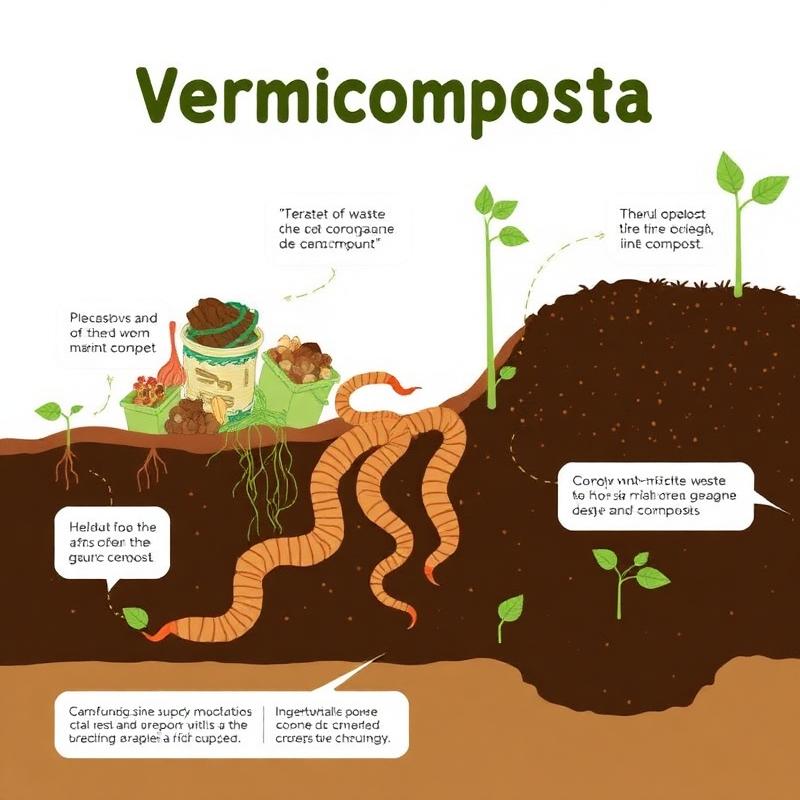
For most Indian balcony and terrace pots, vermicompost is better than cow dung manure. Cow dung wins for outdoor beds when it is fully decomposed. Chemical fertilizer is the fastest fix for a known deficiency, but it is also the easiest one to overdo in a small pot.
Updated July 2026 for Indian home gardeners comparing options before they buy vermicompost or manure online. The table below still matches how we advise customers on pots vs outdoor beds.
Think of it like feeding a person. Chemical fertilizer is a quick energy drink: fast, strong, useful in the right moment, but not a full meal. Cow dung manure is raw groceries: cheap and useful, but it needs time to cook. Vermicompost is a ready, slow meal for the soil: already broken down by worms, mild, and easy for roots to handle.
Quick verdict
Vermicompost vs cow dung vs chemical fertilizer
| Question | Vermicompost | Cow dung manure | Chemical fertilizer |
|---|---|---|---|
| What is it best at? | Feeding soil gently | Adding bulk organic matter | Giving exact nutrients fast |
| How fast does it work? | Slow and steady | Slow after it decomposes | Fast |
| Root burn risk in pots | Very low when mature | High if fresh or half-rotted | High if used too much |
| Best use | Pots, seedlings, indoor plants, vegetables | Outdoor beds, farm patches, soil preparation | Hydroponics, large fields, diagnosed deficiencies |
| Main weakness | Not instant | Needs time and clean sourcing | Can build salts in containers |
| Easy analogy | Ready slow meal | Raw groceries | Energy drink |
Vermicompost or cow manure — which is better?
If your plants live in pots, choose vermicompost. Cow manure (cow dung khaad) is better when you are building or refreshing large outdoor soil and you can wait for full decomposition. The difference is not “organic vs organic” — it is pot volume vs bed volume, and burn risk.
- Balcony / terrace pots: vermicompost wins — mild, already processed, low burn risk.
- Indoor plants: vermicompost in light doses.
- Outdoor beds / farm patches: well-rotted cow dung manure for bulk organic matter.
- Fresh cow dung in pots: avoid — ammonia, salts and heat can damage roots.
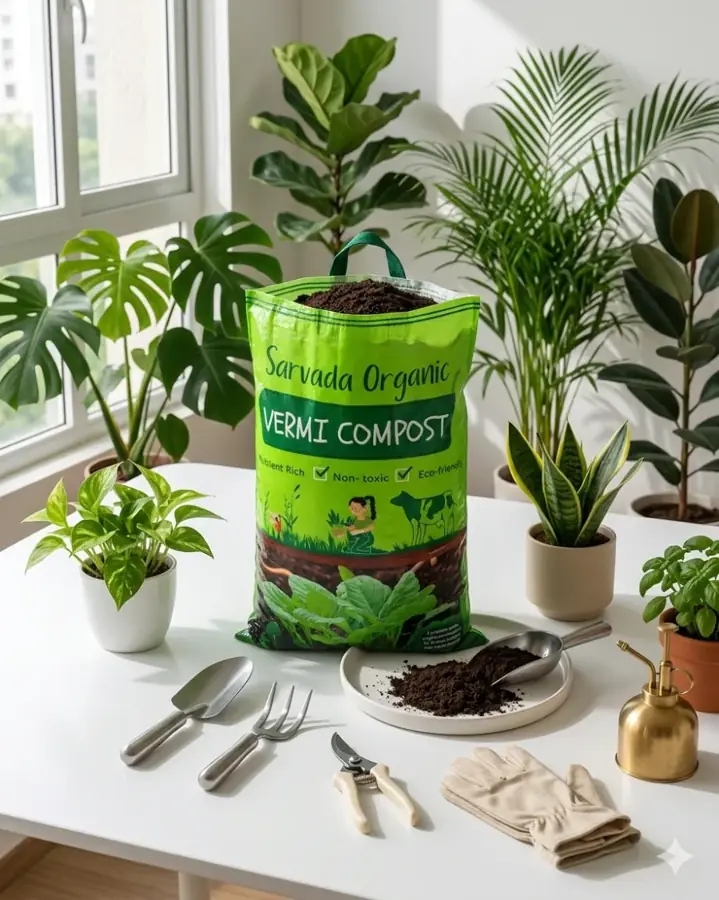
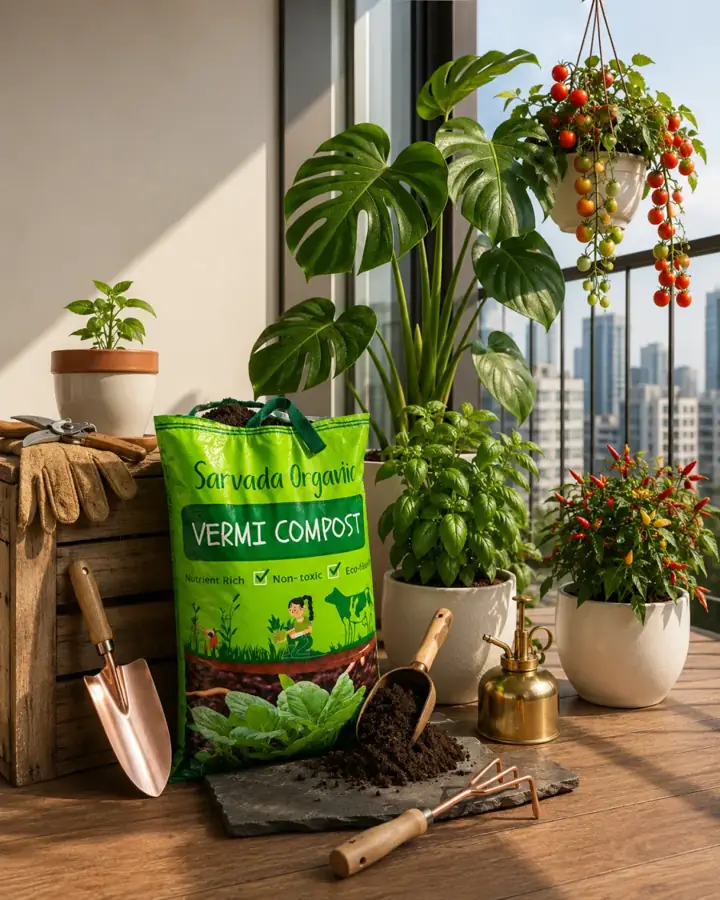
Buy pure vermicompost for pots
Why vermicompost is easiest for pots
Pots are small. That is the whole story. A plant in the ground can send roots deeper and wider when the top layer gets too strong. A plant in a 10-inch pot has nowhere to run, so mild feeding matters more than raw power.
University guides usually keep worm compost around one quarter of a container mix. University of Alaska Fairbanks Extension gives a potting mix with one part castings and three other parts, and Oregon State Extension gives 25% as a typical container mix level. That matches the practical home rule: one scoop vermicompost for three or four scoops of base mix.
Worm castings are also mild. LSU AgCenter notes that worm castings can be used fresh and will not burn plants, and that their N-P-K can vary widely based on what the worms ate. A 2019 meta-analysis found better average yield and root growth with vermicompost, but the useful lesson for home gardeners is simpler: use it as part of the soil, not as the whole soil.
- Use it for balcony vegetables like tomato, chilli and brinjal.
- Use it for indoor plants like money plant, snake plant and palms.
- Use it for seedlings once they have a few true leaves.
- Use it when you want a forgiving monthly routine.
When cow dung manure is better
Cow dung manure wins when you have soil space and time. It adds bulk, improves soil texture, and is usually cheaper per kilogram than vermicompost. For a farm patch or a large outdoor bed, that matters.
The important word is decomposed. TNAU Agritech describes farmyard manure as a decomposed mix of dung, urine, bedding and fodder leftovers, with average nutrients around 0.5% nitrogen, 0.2% P2O5 and 0.5% K2O. It also notes that farmyard manure takes about four to five months to become ready, and that not all nutrients are available to the first crop at once.
Fresh cow dung is different. It can contain ammonia, salts, weed seeds and harmful bacteria. Colorado State University Extension says fresh manure can burn plants because of high ammonia and salts, and that fresh manure needs months before harvest in food gardens. That is why fresh dung in a pot is a bad bargain: it is cheap, but one hot pocket near the roots can undo the saving.
- Use well-rotted cow dung manure before planting a raised bed.
- Use it in outdoor soil where smell and bulk are manageable.
- Do not use fresh cow dung in indoor pots, seed trays or balcony food pots.
- If it smells sharp like ammonia, it is not ready for delicate roots.
When chemical fertilizer makes sense
Chemical fertilizer is not the villain. It is concentrated and direct. If a tomato plant has a clear calcium problem, a targeted calcium feed works faster than waiting for any compost to break down. If someone is growing hydroponically, there is no soil food web to feed, so measured nutrient salts are the system.
The risk is overuse. Texas A&M AgriLife explains that soluble salts build up from over-fertilization and can injure roots. University of Maryland Extension says over-application of water-soluble fertilizers can burn or injure plants because salts pull water out of roots and leaves.
In open fields, salts can be managed with soil testing, irrigation and measured rates. In a balcony pot during May heat, the same mistake is harsher. Water evaporates, salts stay behind, and the plant looks thirsty even when the soil is wet.
- Use chemical fertilizer when the deficiency is clear.
- Use it when the crop system is built for precise feeding.
- Do not use it weekly just because leaves look pale.
- Do not mix strong chemical fertilizer and heavy compost feeding on the same day.
Best choice by situation
| Situation | Best choice | Why |
|---|---|---|
| 6-12 inch balcony pot | Vermicompost | Small soil volume needs mild, slow feeding |
| Indoor foliage plant | Vermicompost, light dose | Low light means slow nutrient use |
| New raised bed | Well-rotted cow dung plus compost | Large soil volume can use bulky organic matter |
| Tomato with confirmed calcium deficiency | Targeted chemical feed | Specific deficiency needs fast correction |
| Hydroponic setup | Chemical nutrient solution | There is no soil for compost to work through |
| Seedlings and cuttings | Very light vermicompost | Young roots need gentle nutrition |
The common mistakes
- Using fresh cow dung in pots. It may heat, smell, release ammonia, carry weed seeds, or burn young roots.
- Treating chemical fertilizer like monthly food. It is better used like medicine: correct product, correct dose, correct reason.
- Using vermicompost as 100% potting soil. Mix it with soil, cocopeat, leaf mould, rice husk, sand or perlite so roots still get air.
- Thinking N-P-K is everything. Plants need nutrients, but pots also need drainage, air, microbes, moisture balance and enough sunlight.
The verdict for Indian home gardeners
The honest verdict
What about Indian summer?
In Delhi, Jaipur, Ahmedabad, Mumbai, Pune, Hyderabad and Bengaluru summers, terrace pots dry from the outside while the inner soil may still be wet. This is exactly when strong feeding causes confusion: brown tips, drooping leaves, wet soil, and a gardener who adds even more water.
In hot months, keep the rule boring. Feed lightly with vermicompost in the evening, water once, and mulch with dry leaves or coco chips. Avoid fresh dung. Use chemical fertilizer only at low dose and only when the plant is actively growing, not when it is already heat-stressed.
Frequently asked questions
For potted home plants, vermicompost is better because it is mild, already processed, and safer in small soil volume. Cow manure is better for outdoor beds when it is fully decomposed.
Vermicompost for balcony, terrace and indoor pots. Well-rotted cow dung manure for raised beds and outdoor soil preparation. Do not use fresh cow dung in pots.
Vermicompost is worm-processed castings — ready to use and gentle. Cow dung manure is bulkier farmyard organic matter that needs months to decompose before it is safe and useful near roots.
For most Indian home pots, vermicompost. For large outdoor beds with time to prepare soil, well-rotted cow dung. Chemical fertilizer only for a diagnosed deficiency.
No, chemical fertilizer is not automatically bad. It is useful for diagnosed nutrient deficiencies, hydroponics, and large-scale farming, but too much can build salts and burn roots in pots.
Yes, but it makes more sense in raised beds and outdoor soil. For small pots, use vermicompost alone or use only a small amount of fully rotted cow dung mixed into the base soil.
No. Fresh cow dung can contain ammonia, salts, weed seeds and harmful bacteria. In a small pot it can smell, heat up, and damage young roots.
For most balcony, terrace and indoor plants, yes, vermicompost can be the regular fertilizer. It will not replace a fast targeted treatment when a plant has a confirmed nutrient deficiency.
Use light vermicompost feeding in the evening and mulch the pot surface. Avoid fresh cow dung and avoid strong chemical feeding when plants are already heat-stressed.
Try Sarvada Organic
Pure vermicompost from ₹249 · Lab N 3.16%
No silt, no preservatives. Free delivery above ₹499 and Cash on Delivery on Amazon.
Buy on Amazon