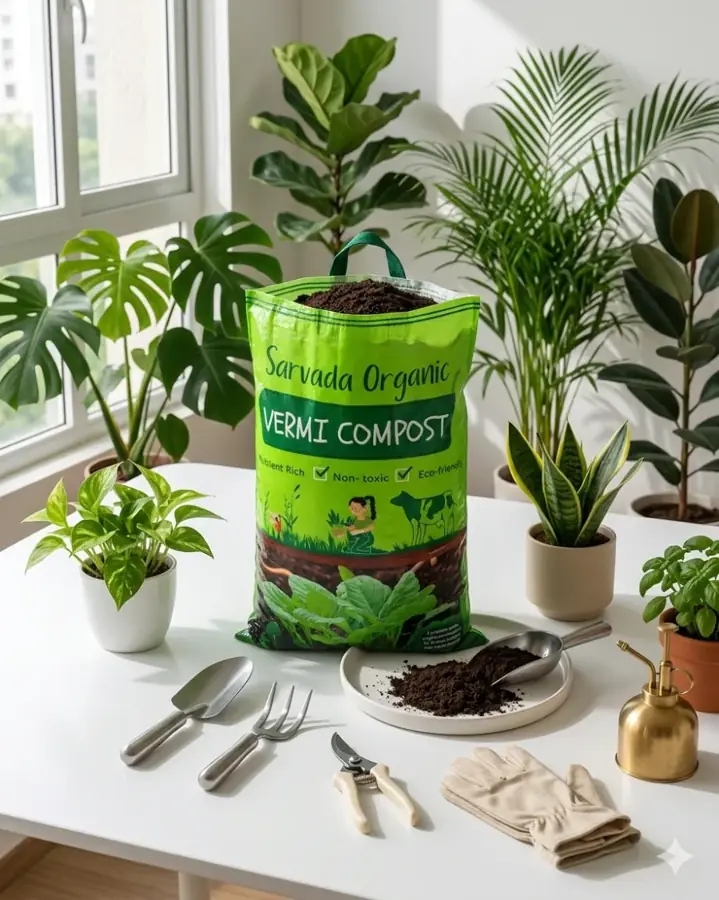
What growing your own food does to you that nobody talks about
Not a how-to. Just an honest essay about what a few balcony pots quietly change in your day, your food and your attention.
By Sarvada Farm Team
From Sarvada Organic's farm team, based on small-batch vermicompost production and Indian balcony-garden support since 2018.
Growing your own food changes your attention before it changes your diet. One pot of methi on a balcony can make you notice water, sunlight, waste, patience, and the work behind every handful of leaves on your plate.
This is not a plant-care guide. It is about the quiet part of kitchen gardening: what starts happening inside you when food stops being only a packet, a delivery, or a bunch from the market.
Short version
You stop eating on autopilot
The first change is small. You cut your own methi into dal and suddenly the leaves are not garnish. They are 24 days of watering, checking, moving the pot into better light, and wondering if you did something wrong because the first two leaves looked too tiny.
After that, food becomes harder to ignore. You notice coriander stems. You save mint cuttings. You look at the sabzi mandi differently because now you know every bunch was once somebody's plant.
Your day gets one small anchor
A balcony garden asks for very little, but it asks every day. Ten minutes in the morning. One round in the evening during summer. No big promise, no transformation plan, no app streak. Just a plant that will droop if you forget it.
That sounds like a burden until it becomes the opposite. Watering gives the day a small beginning. Checking new leaves gives the mind one soft place to land before the phone takes over.
What the research actually says
The research does not say gardening is magic. It says something more believable. A 2017 meta-analysis of 22 gardening studies found positive links with several health outcomes, including lower depression and anxiety measures and higher life satisfaction, quality of life, and sense of community.
In one small field experiment, 30 allotment gardeners did a stressful task and then spent 30 minutes either gardening or reading. Both helped cortisol come down, but the gardening group showed stronger cortisol recovery and restored positive mood. That does not make gardening a replacement for care. It does explain why a small pot can feel oddly steadying after a hard day.
Plain version
You learn patience without a lecture
Seeds do not care about your calendar. Methi may show up in three to five days. Chilli can test your patience for weeks. Tomato flowers may appear and then drop because the balcony is too hot. You learn that "nothing is happening" is often just the part where roots are working underground.
This kind of patience is not motivational. It is practical. You water, you wait, you adjust one thing, and eventually you stop pulling the plant out of the soil just to check if it is growing.
You learn loss in a small, useful way
Some plants die. A May weekend without water can finish a mint pot. One hidden mealybug can spread from hibiscus to curry leaf. Sometimes the seedling bends at the stem and never recovers.
It hurts more than you expected, but it is a clean kind of hurt. You learn that care improves the odds; it does not give you control. That is a hard lesson, and plants teach it gently because you can always sow again.
You waste less because you know the cost
A homegrown chilli is not expensive in rupees. It is expensive in attention. Once you know that, the half bunch of coriander dying in the fridge starts looking different. So do tomato seeds, curry leaves, onion tops, and the wet kitchen waste you used to throw away without thinking.
Food becomes less invisible. Not precious in a fancy way. Just visible. You start using stems in chutney, saving mint in water, and cutting only what you need from the pot.
You join a quiet community
Plant people find each other without trying. The neighbour who gives you a curry leaf cutting. The watchman who tells you your tomato needs more sun. The auntie in the lift who knows exactly why your hibiscus has yellow leaves.
It is not a formal community. It is smaller and warmer than that: a cutting passed from one balcony to another, a photo of the first harvest sent to the family group, someone saying, "Try methi first, it never argues."
You touch family memory
Many Indian homes have a plant memory somewhere. Tulsi near the door. A curry leaf plant in an old paint bucket. Methi on a kitchen ledge. A guava tree from a grandparent's house. You may not have been taught the method, but the feeling is familiar.
The first time you crush a tulsi leaf between your fingers, something old wakes up. Not nostalgia exactly. More like recognition.
Start smaller than your excitement
Do not begin with 20 pots. Begin with three: methi, tulsi and chilli. One shallow tray, one 8-inch pot, one 12-inch pot. That is enough to learn watering, sunlight, feeding, pests, patience and harvest.
If you stay with those three for one month, the garden will tell you what to add next. Usually mint. Sometimes tomato. Very often one more chilli because the first harvest feels like a small personal victory.
None of this is in the product description
A product page can say vermicompost, no silt, no preservatives, good for balcony vegetables. All true. But that is not the whole reason people keep growing.
They keep going because one morning there are three new leaves. Because a child eats one tomato straight from the pot. Because a tired adult gets ten quiet minutes before opening email. Because the first harvest is small enough to fit in one palm and still somehow changes the room.
Frequently asked questions
A 2017 review linked gardening with better mood, lower stress measures, and higher life satisfaction for many people. It is not a replacement for medical care, but it can be a useful daily support.
Yes. Even a small balcony or sunny window can grow methi, tulsi, mint, coriander, chillies, spinach, microgreens, and sometimes cherry tomatoes.
Methi is the easiest first crop. It germinates quickly, grows in shallow trays, and gives a small harvest in about three to four weeks.
A 3-5 pot kitchen garden usually needs 10-15 minutes a day. Most of that is watering, checking leaves, moving pots for light, and removing dry growth.
Start with methi, tulsi and chilli. This gives you one quick harvest, one daily-use herb, and one longer crop that teaches patience.
That is normal. Plant death is part of learning watering, light and drainage. Start again with fewer pots and change only one thing at a time.
Yes. Mature vermicompost is gentle and forgiving, which makes it easier for new gardeners than strong chemical feeding or silt-heavy compost.
Try Sarvada Organic
Pure vermicompost from ₹249 · Lab N 3.16%
No silt, no preservatives. Free delivery above ₹499 and Cash on Delivery on Amazon.
Buy on Amazon